

When Will Decentralized Finance Fix the Oracle Problem? Lessons from the Crash
Discover how the 292 million KelpDAO bridge exploit almost collapsed Aave in April 2026. Learn why Ethereum DeFi failed and how Bitfinity on Bitcoin fixes it.

Imagine someone hacking a bank, but instead of breaking into the vault, they hack the armored truck company responsible for telling the bank how much gold is in the vault. That is basically what happened to decentralized finance (DeFi) in April 2026.
The KelpDAO bridge exploit was a stress test for the entire idea of composable finance, the belief that different protocols can safely plug into each other like Lego bricks.
A staking protocol can connect to a restaking protocol, which can connect to a liquid token, which can connect to a bridge, which can connect to a lending market. Capital moves faster, yields stack higher, and users get access to financial products that traditional banks could never build.
But Lego towers collapse when one brick near the bottom is fake. Let's take a look at how this happened.
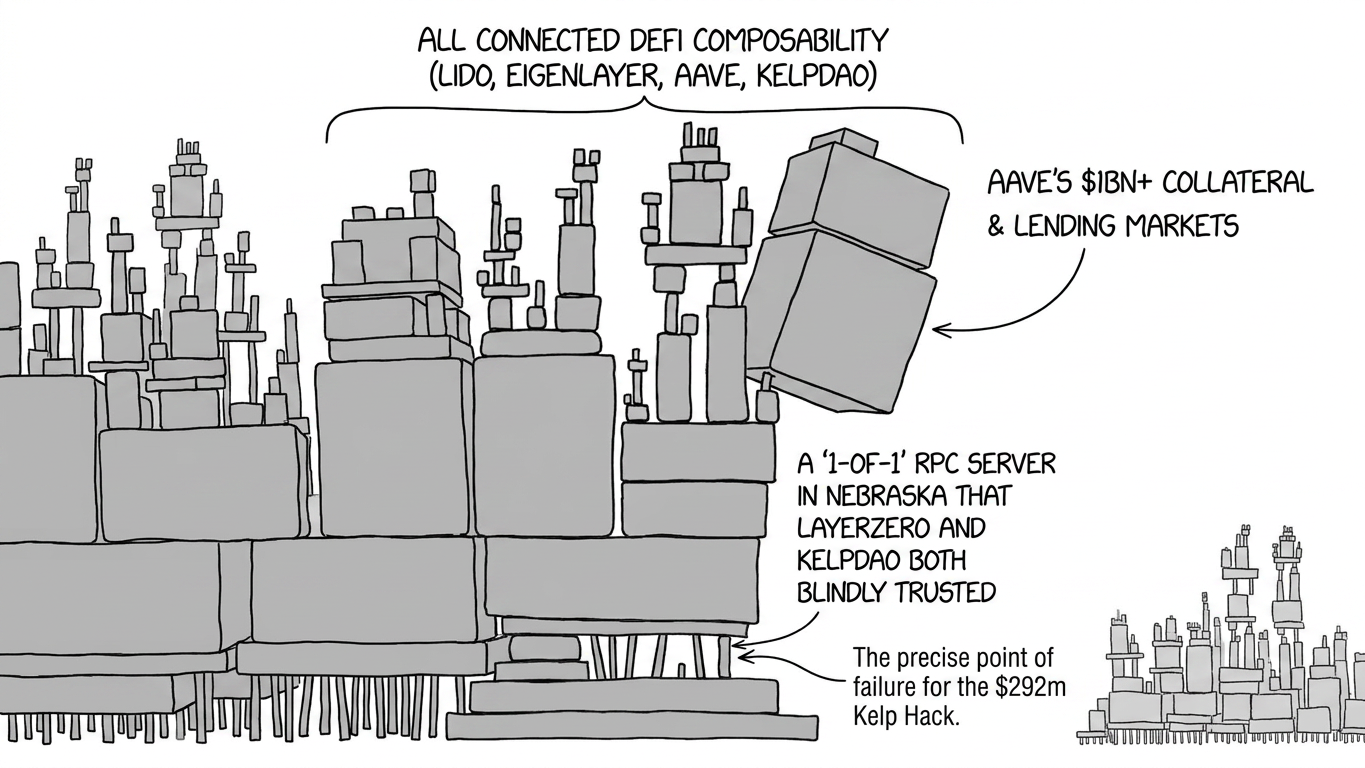
The KelpDAO Bridge Exploit in a nutshell
Attackers—highly suspected to be North Korea's Lazarus Group—exploited the LayerZero system, a "bridge" used to connect different blockchains.
By hijacking the system's communication network, they essentially forged counterfeit deposit receipts, allowing them to create 116,500 rsETH tokens out of thin air, worth about 292 million USD at the time.
Then came the domino effect ("composability"). The hackers took these counterfeit tokens to Aave, the biggest lending platform in crypto, and used them as collateral to borrow 190 million USD in real assets. When everyone realized Aave was backed by fake money, a total market meltdown and freeze loomed.
I'm dropping a thread of all the protocols that had to freeze their interop because of LayerZero being compromised.
— Fishy Catfish (@CatfishFishy) April 19, 2026
Let's go:
The Anatomy of the Exploit
To understand how hackers drained nearly 300 million USD so easily, you have to realize one shocking fact: the hackers didn't actually "break" the crypto code. Instead, they attacked the plumbing.
They targeted LayerZero, the infrastructure built to read data from one blockchain and report it to another. LayerZero relies on verification networks to ensure these cross-chain messages are true.
However, KelpDAO's specific setup relied on a "1-of-1" configuration. In simple terms: LayerZero was the only entity checking the math. A MASSIVE SINGLE POINT OF FAILURE.
Here is how the trap was sprung: Hackers broke into LayerZero's internal data servers (known as RPC nodes). At the exact same time, they launched a cyberattack (a DDoS) against the backup external servers, knocking them offline.
With the alarms disabled and the data servers compromised, the hackers fed the system a lie. They told the system, "We just deposited a massive amount of rsETH tokens on blockchain A," even though they hadn't. Because the system was set up to blindly trust that single compromised server, it rubber-stamped the lie as truth.
Acting on this forged approval, the destination bridge contract obediently minted 116,500 brand-new rsETH tokens and handed them to the hackers. The hackers then rushed to the Aave lending platform to cash out before anyone realized the tokens were unbacked.
Fortunately, KelpDAO's security team noticed the anomaly and within an hour, they hit the emergency brakes and pausing the system from forging a second receipt for another 40,000 rsETH (worth 95 million USD).
How a "Leveraged Loop" Poisoned Aave
Why did a hack on a cross-chain bridge suddenly threaten to destroy Aave, a completely different platform? The answer lies in a highly risky crypto trading habit known as "leveraged looping."
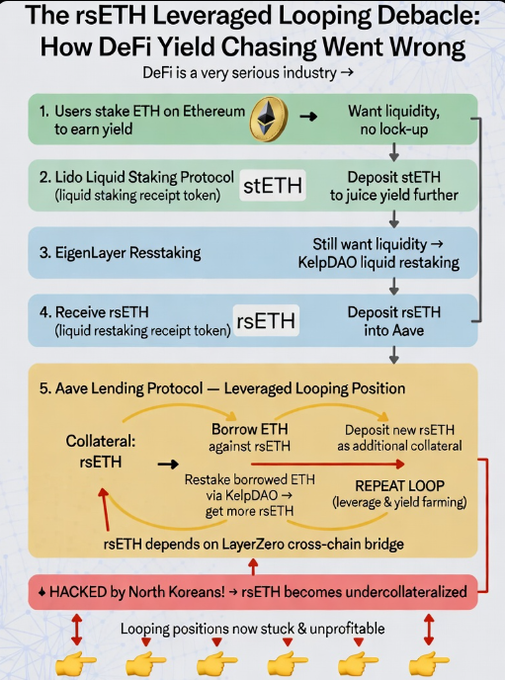
In the months leading up to the attack, traders found a clever way to juice their profits. They would deposit rsETH into Aave, use it as a deposit to borrow regular ETH, convert that borrowed ETH into more rsETH, and then deposit it back into Aave to borrow even more.
They spun this loop over and over, multiplying their projected payouts—but secretly multiplying their risk.
When the LayerZero hack hit, the true value of rsETH dropped to zero overnight. Suddenly, Aave was holding a massive bag of worthless tokens backing nearly 190 million USD in real, borrowed assets.
Normally, when a borrower's collateral drops in value, Aave's automated system "liquidates" them by selling off the collateral to pay back the loan. But in this case a terrifying mathematical reality set in: Aave couldn't sell the collateral because no one wanted to buy fake tokens and Aave was left staring at up to 200 million USD in "bad debt".
DeFi United: A $161 Million Bailout
In the panicked hours after the KelpDAO hack, an unprecedented rescue mission began. Aave's founder rallied executives from a dozen of crypto's wealthiest and most powerful organizations to create an emergency recovery fund called "DeFi United."
Together, this coalition scraped together 69,642 ETH—worth roughly $161 million—with total pledges eventually swelling past $$300 million. Their goal was to replace the stolen money backing rsETH so that Aave wouldn’t completely collapse and freeze the entire lending market.
By injecting their own cash to cover the hole left by the hackers, this coalition brought Aave back from the brink of ruin. Crypto media cheered, calling the bailout a beautiful example of how decentralized finance can "self-heal" during a crisis. A wall Street-style bailout by a new class of oligarchs, desperately trying to save an ecosystem that had completely misjudged its own risks.
Is "Code Is Law" Dead?
This case highlights a massive, unavoidable weakness in crypto known as the "Oracle Problem."
By design, smart contracts are completely blind to the outside world. They can only read what is on their specific blockchain. To know what is happening anywhere else, they rely on external messengers (called oracles or bridges). In this case, LayerZero was the messenger. It told Aave’s smart contract, "This rsETH is fully backed and perfectly safe." Aave’s code flawlessly executed instructions based on a massive lie.
But in today’s hyper-connected crypto ecosystem, separating "our code" from "their lie" is a meaningless excuse. A protocol cannot accept tokens as collateral, allow billions of dollars in loans against them, and then shrug its shoulders when the messenger gets hacked.
These platforms are not isolated islands. They form a unified financial web. When a simple server mistake on one bridge can instantly wipe out 292 million and create up to $200 million in bad debt elsewhere, claiming "our code worked" is exactly the kind of hollow excuse that governments will eventually use to regulate DeFi into the ground.
 Fred
Fred
What This Means for Everyday Depositors
For ordinary users caught in the crossfire of the KelpDAO hack, the immediate goal became simple: get out while you still can. Users who had deposited regular Ethereum (WETH) into Aave faced a terrifying choice. They could rush to withdraw their funds immediately, or they could stay put, hoping Aave’s emergency safety net—called the Umbrella system—would stop the bleeding.
Crypto veterans remember MakerDAO's "Black Thursday" in 2020, where panic caused the exits to jam and liquidity to dry up completely. Users who hesitated on Aave risked having their money trapped in frozen smart contracts while executives argued over how to fix the mess.
But the most brutal reality fell on the "yield farmers", the traders who used rsETH to build complex webs of debt to earn massive returns and who watched their portfolios drop instantly to zero.
The lesson learned here is devastating: when you stack risky IOUs on top of other IOUs across multiple platforms, one hacked server is all it takes to wipe you out completely.
Why Bitcoin's Network Fixes This...
The recent issues involving KelpDAO and Aave highlight some of the risks in highly interconnected DeFi ecosystems on Ethereum. Many protocols depend on external bridges, oracles, and RPC infrastructure, so when one part fails, the effects can spread quickly across multiple platforms.
These incidents have renewed discussions around infrastructure reliability, dependency risks, and the challenges of building complex financial systems on interconnected smart contracts. ☢️🦦
Conclusion
Perhaps the biggest annoyance with modern DeFi is that most projects still do not take the absolute bare minimums of security seriously. We don't always need groundbreaking computer science to prevent a $300 million meltdown; we just need common sense.
The industry must adopt standard security hygiene across the board:
- All bridges must have rate limits to prevent infinite minting during a compromised server event.
- All lending markets should have rate limits to throttle the speed at which bad debt can cascade.
- Multisig actions must be rebuilt, requiring an "instant pause" feature, alongside time-locked updates that include a mechanism to correct erroneous actions before they execute.
Until these baseline security practices are treated as mandatory, and until the industry embraces the architectural superiority of building on Bitcoin, users will continue to play Russian roulette with their money in an easily manipulated system.
Connect with Bitfinity Network
Bitfinity Wallet | Bitfinity Network | Twitter | Telegram | Discord | Github
*Important Disclaimer: The information provided on this website is for general informational purposes only and should not be considered financial or investment advice. While we strive for accuracy, Bitfinity makes no representations or warranties regarding the completeness, accuracy, or reliability of the content and is not responsible for any errors or omissions, or for any outcomes resulting from the use of this information. The content may include opinions and forward-looking statements that involve risks and uncertainties, and any reliance on this information is at your own risk.



Comments ()