

Bitcoin’s Quantum Moment: Google’s Warning and BIP‑360’s Response
Google's 2026 quantum research reveals Bitcoin's encryption could be broken with far fewer qubits than expected. Discover how quantum computers threaten Bitcoin, what BIP-360 proposes, and whether the community can adapt in time.
For years, the narrative of quantum computers breaking Bitcoin has existed only as speculation, thought to require decades of technological breakthroughs that might never be fully attained.
But on March 30, 2026, this narrative shifted when Google's Quantum AI team published a whitepaper that showed breaking Bitcoin wallet cryptography could require fewer than 20 times the quantum resources previously estimated.
This research has left us with two main questions: Is Bitcoin actually at risk, or just early in a transition cycle that has years to play out?

What Is Quantum Computing?
Quantum computing is an approach to computing that uses the rules of quantum physics to process information in ways normal computers cannot. Rather than processing information using traditional bits (which are either 0 or 1), quantum computers leverage qubits (quantum bits), which can exist as 0, 1, or both simultaneously.
As a result, these computers can explore many possibilities in parallel, making them theoretically capable of solving certain mathematical problems orders of magnitude faster than any classical computer.
When Did We Realize Quantum Computers Could Break Encryption?
1994: Shor's Algorithm – The ECDSA Threat
The quantum computing threat to cryptography became real in 1994, when mathematician Peter Shor discovered an algorithm that could factor large numbers exponentially faster than any known classical method.
Why does this matter for Bitcoin? The security of Bitcoin's signature scheme (ECDSA) relies on a similar mathematical problem, specifically, the difficulty of solving the "discrete logarithm problem" on elliptic curves.
1996: Grover's Algorithm – The Hashing Concern
Two years later, Lov Grover introduced another breakthrough: an algorithm that speeds up searching through unsorted data. This affects Bitcoin's hashing algorithms (like SHA-256), but far less severely than Shor's algorithm affects signatures.
Grover's algorithm provides what cryptographers call "quadratic speedup." In practical terms, SHA-256's 256-bit security drops to approximately 128-bit security against quantum attacks, still extremely secure by today's standards.
Early Bitcoin Community Awareness
Interestingly, Bitcoin's creator was aware of this threat from the beginning. In a 2010 BitcoinTalk forum discussion, Satoshi Nakamoto directly addressed quantum computing risks. He acknowledged that a sudden breakthrough in quantum technology could create serious vulnerabilities, but emphasized that gradual development would give the Bitcoin community time to implement protective measures.
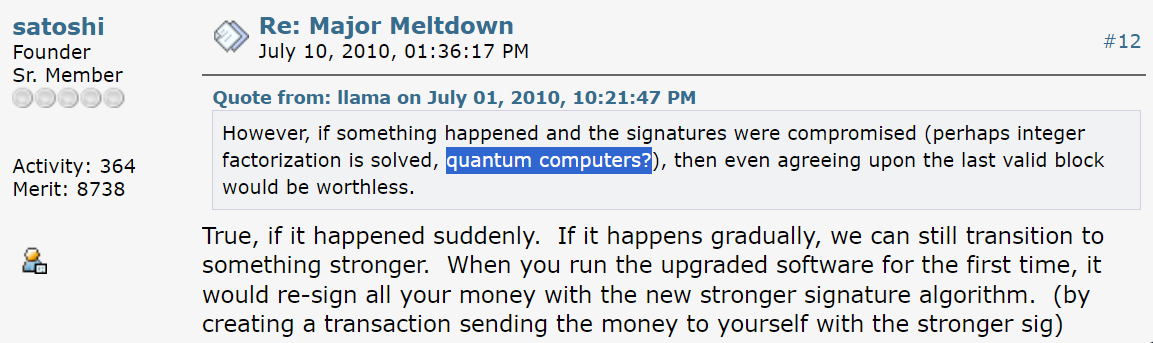
Unfortunately, the topic was closed without extending beyond its first page, and Satoshi did not offer a more detailed proposal on the changes that could be implemented.
Why is Bitcoin Vulnerable to Quantum Computers?
The Public Key Exposure Problem
Bitcoin uses ECDSA (Elliptic Curve Digital Signature Algorithm) for signatures, which relies on the elliptic curve discrete logarithm problem. This mathematical puzzle is virtually impossible for classical computers to solve in reverse, but quantum computers running Shor's algorithm can crack it exponentially faster.
 Fred
Fred
Different Address Types, Different Risk Levels
Your public key only becomes visible when you spend bitcoin from an address. Before that first transaction, only a cryptographic hash is visible on the blockchain, providing extra protection, as long as you don't reuse addresses.
The Legacy Address Problem
Bitcoin's earliest addresses used Pay-to-Public-Key (P2PK) format, which displayed the full public key on the blockchain from the moment they were created, no spending required. These addresses are sitting ducks for quantum attacks.
According to blockchain analytics firm Project Eleven, approximately 6.9 million BTC currently sit in addresses with exposed public keys. This includes Satoshi Nakamoto's early mining rewards, which remain in the original P2PK format.
Fun fact: Bitcoin's SHA-256 remains relatively strong against quantum computers. Even with Grover's algorithm, attackers only get a modest speed boost, not a breakthrough.
 Fred
Fred
For years, the hardware requirements to execute quantum attacks on Bitcoin seemed safely distant, perhaps decades away. But on March 30, 2026, Google dropped a bombshell…
The Google Research: Is Bitcoin’s Doomsday Near?
In March 2026, Google's Quantum AI team, collaborating with cryptographers from Stanford University and the Ethereum Foundation, published a landmark paper that fundamentally transformed the discussion around Bitcoin's quantum security. For the first time, researchers presented a plausible near-term scenario in which a sufficiently powerful quantum computer could compromise Bitcoin transactions within minutes, not decades.


Why Nine Minutes Is the Danger Zone
Here's how Bitcoin works in practice: When you send bitcoin, your transaction first enters a public waiting area called the mempool. On average, it takes about ten minutes for miners to confirm your transaction in a new block. Once confirmed, the transaction becomes immutable and secure.
The risk window appears during that waiting period.
When you broadcast your transaction, you simultaneously expose your public key, which is mathematically derived from your private key. A quantum computer powerful enough could—in theory—exploit Shor's algorithm to derive your private key from that exposed public key before the transaction finalizes.
According to Google Quantum AI's resource estimates, a future device with roughly 500,000 error-corrected (logical) qubits could execute the attack under optimized conditions in as little as nine minutes—barely shorter than Bitcoin's own block interval.
In that scenario, an attacker could:
- Detect your public key the moment you broadcast a transaction
- Compute your private key in approximately nine minutes
- Broadcast a counterfeit transaction spending the same coins first
Because miners would only include one of these transactions in the blockchain, the attacker's version could be confirmed instead of yours, effectively stealing your funds. The study estimates such an "on-spend" attack might succeed around 40% of the time under idealized conditions. It's not a guarantee—but it's far too close for comfort.
How Close Are We to This Reality?
Google's current "Willow" superconducting quantum chip (released in late 2024) operates with about 105 physical qubits. Reaching the "danger zone" of approximately 500,000 error-corrected qubits requires orders of magnitude more scale—roughly five-thousand-fold higher effective power once error correction overheads are accounted for.
That still sounds distant, but Google's actions speak volumes: they've brought forward their internal deadline to migrate all systems to post-quantum cryptography by 2029. Corporations do not overhaul planet-wide infrastructure "for fun."
This timeline implies Google's researchers believe cryptographically relevant quantum computers (CRQCs) could emerge within three to five years, not decades.
The question now is: Are Bitcoin's developers ready to act in time?
ADAM BACK JUST ABSOLUTELY DESTROYED #BITCOIN QUANTUM FUD LIVE ON BLOOMBERG
— The Bitcoin Historian (@pete_rizzo_) April 8, 2026
QUANTUM COMPUTERS ARE "EXTREMELY BASIC"
WE STILL HAVE "A DECADE" TO PREPARE
DON'T BELIEVE THE FUD. HODL 🚀 pic.twitter.com/TASUvKJuer
BIP-360: Bitcoin's First Quantum Upgrade
In response to the quantum threat, Bitcoin developers have proposed BIP-360: "Pay-to-Merkle-Root (P2MR)." Co-authored by Hunter Beast, Ethan Heilman, and Isabel Foxen Duke, the proposal was added to the Bitcoin repository in 2026.
How P2MR Works
BIP-360 introduces a new address type through a soft fork. P2MR functions similarly to Taproot addresses but with one critical difference: it removes "key path spending"—the feature that directly exposes your public key during simple transactions.
Instead, P2MR forces all transactions through "script paths," which rely on Merkle trees and SHA-256 hash functions for verification. Since SHA-256 is quantum-resistant (Grover's algorithm only provides modest speedup), this eliminates the ECDSA vulnerability window entirely during spending.
The trade-off? P2MR transactions are larger and more complex than standard Taproot transactions, but they preserve important Bitcoin features like multisignature wallets and timelocks.
A BTC transaction could cost up to 20x more if triple locked with all 3 quantum-resistant algorithms proposed in #BIP360 - and 2x if using the basic one.
— Anduro (@andurobtc) May 5, 2025
Is that the fee tradeoff we'll just have to assume to make Bitcoin quantum-resistant?@isabelfoxenduke & @cryptoquick
👇 pic.twitter.com/XdGRm5raMg
Other Post-Quantum Approaches in Bitcoin
BIP-360 isn't Bitcoin's only quantum defense. The community is actively exploring multiple alternatives:
Hash-Based Signatures
These rely entirely on cryptographic hashing (like SHA-256) rather than elliptic curve math that quantum computers can break. The drawback? Larger signature sizes increase blockchain storage requirements. Some schemes, like Winternitz considered for integration with BIP-360, can only sign one transaction. Use it twice, and you reveal enough of the private key for attackers to forge signatures.
Lattice-Based Cryptography
These schemes replace vulnerable ECDSA and Schnorr signatures with high-dimensional mathematical problems that no known quantum algorithm can efficiently solve. Unlike hash-based schemes, they're stateless, allowing multiple transactions without one-time limitations, and significantly faster. They still produce larger signatures than current ones, risking blockchain bloat.

OP_CAT Reintroduction
Some developers advocate reintroducing OP_CAT, an opcode Satoshi originally disabled. If reactivated, it would expand Bitcoin Script's capabilities, making it easier to construct hash-based signature schemes like Lamport or Winternitz using Merkle trees.
 OP_CAT Layer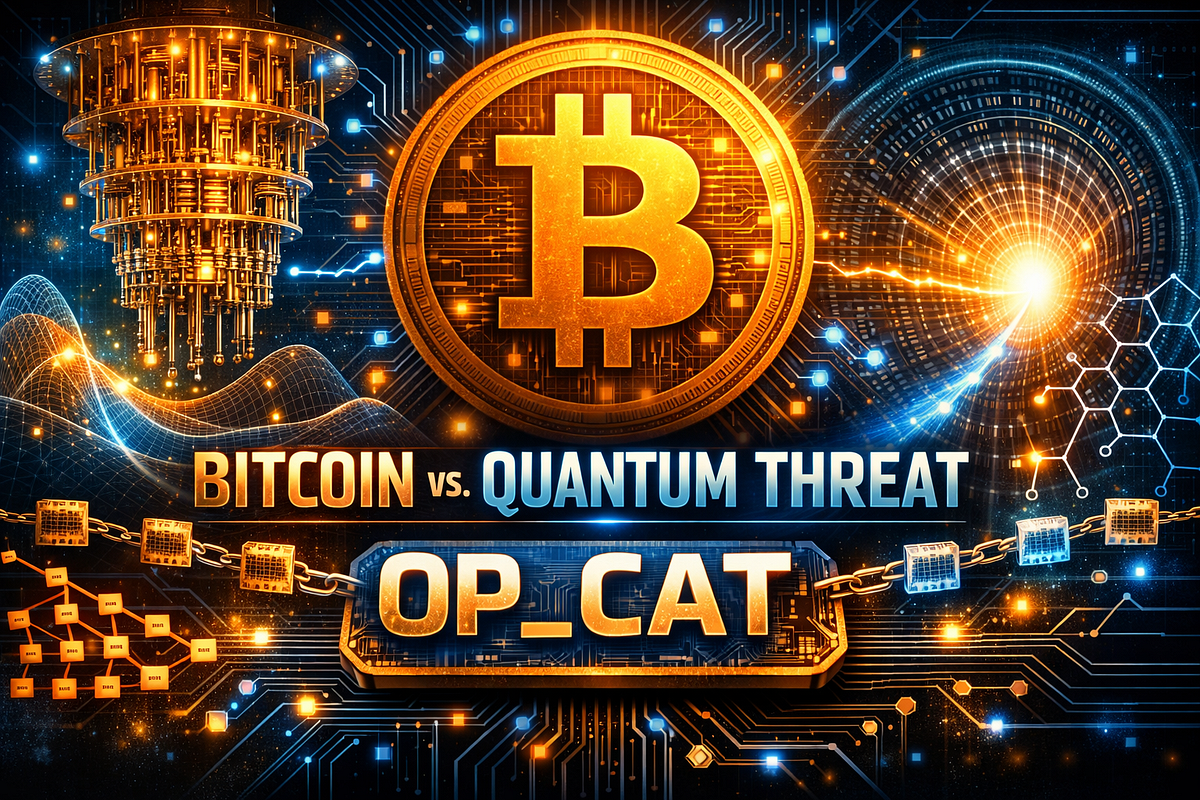
The Bottom Line
Ultimately, the Bitcoin community is far from passive in the face of quantum advancements. While Google's whitepaper may not be the doomsday scenario some portrayed, it has successfully catalyzed a necessary sense of urgency.
With multiple post-quantum solutions already under active development, the primary hurdle ahead is no longer purely technical. Instead, the true challenge lies in aligning the community to reach a consensus on the safest path forward long before a viable quantum threat ever materializes.
Connect with Bitfinity Network
Bitfinity Wallet | Bitfinity Network | Twitter | Telegram | Discord | Github
*Important Disclaimer: The information provided on this website is for general informational purposes only and should not be considered financial or investment advice. While we strive for accuracy, Bitfinity makes no representations or warranties regarding the completeness, accuracy, or reliability of the content and is not responsible for any errors or omissions, or for any outcomes resulting from the use of this information. The content may include opinions and forward-looking statements that involve risks and uncertainties, and any reliance on this information is at your own risk.
External links are provided for convenience, and we recommend verifying information before taking any action. Bitfinity is not liable for any direct or indirect losses or damages arising from the use of this information.

Comments ()