

The Cypherpunk Movement: The Ideological Origins of Bitcoin
Bitcoin didn't appear out of thin air in 2008. Discover the 11 groundbreaking inventions spanning 50 years that laid the foundation for Satoshi's masterpiece.
The concept of a 'blockchain' was actually created in 1991, not to track money, but for digital documents. While popular culture paints Bitcoin as a sudden phenomenon that materialized during the 2008 financial crisis, the reality is far more complex and fascinating. From 1970s electrical engineers to 1990s privacy activists, the 'bricks' of the crypto revolution were being laid long before Satoshi Nakamoto ever wrote a line of code. Let's take a look...
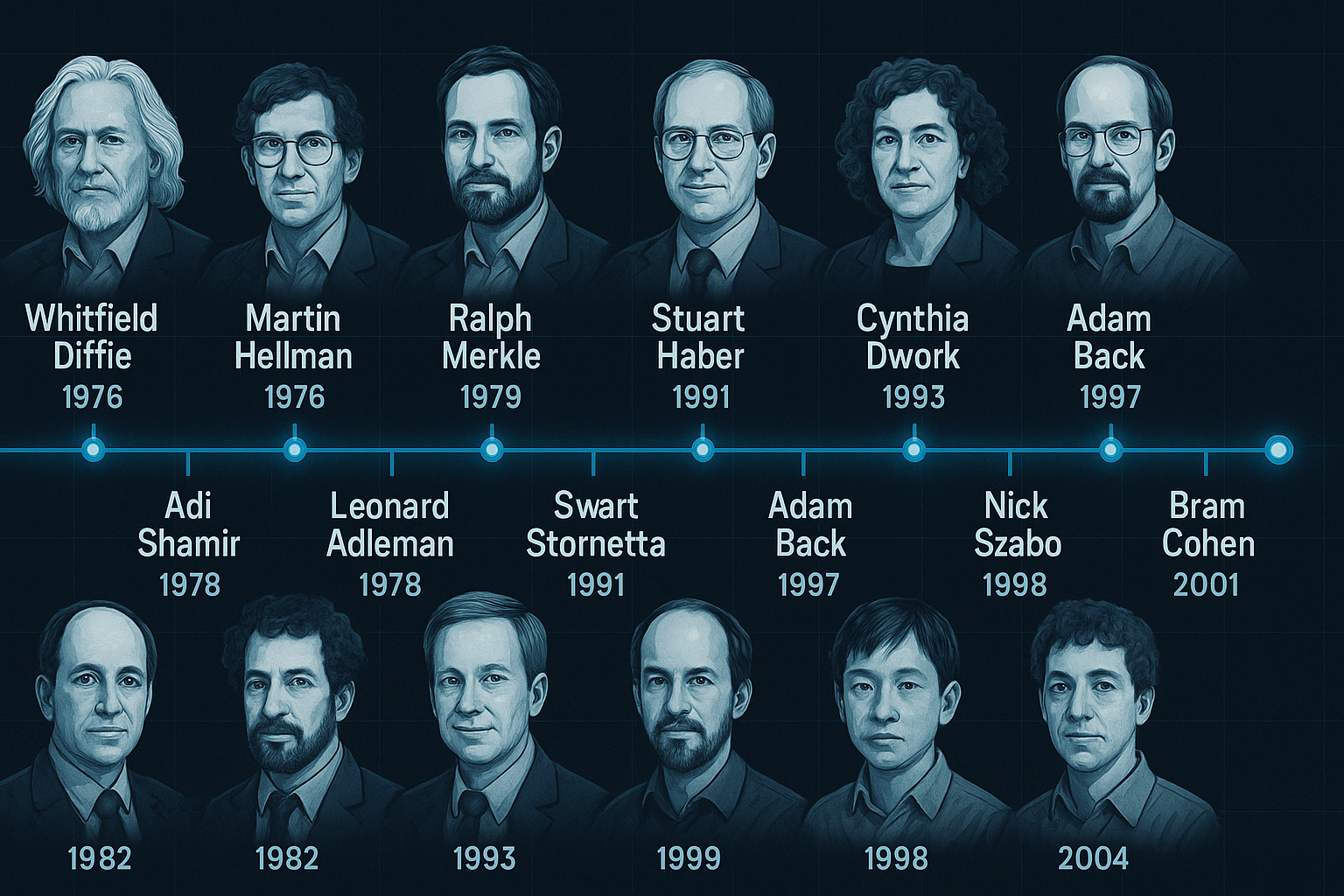
The 11 Bricks That Built the foundation...
To have the properties such as Bitcoin, it did not all happen at once, nor was it the work of a single person; it is a result of decades of work from different individuals and groups. Therefore, let us look at some of them in particular.
Public-Key Cryptography (1976)
The first brick we begin with is public-key cryptography, which today is responsible for Bitcoin wallets. The idea was first introduced in 1976 by two electrical engineering researchers, Whitfield Diffie and Martin Hellman, who were looking for a way to send a secret without trusting the post office or the government.
Their solution was that two parties could establish a shared secret over an insecure channel using a pair of mathematically related keys: a public key, which can be shared openly, and a private key, which must be kept secret.
Conceptually, it works like a ‘magic mailbox’, anyone can drop a message into your box using your public key, but only you can open it with your private key.
But how do you prove that you are the person who meant to send something to that mailbox? That is where the second brick comes in…
Digital Signatures (1978)
In 1978, Ron Rivest, Adi Shamir, and Leonard Adleman introduced the RSA algorithm, named after their initials, which made practical digital signatures possible.
A digital signature allows a person to use their private key to 'sign' a message in such a way that anyone with the corresponding public key can verify that signature but cannot forge it themselves.
Together, public-key cryptography and digital signatures created the basic architecture that Bitcoin still relies on. A Bitcoin address is essentially a representation of a public key, a Bitcoin 'wallet' is, at its core, software that stores private keys and spending Bitcoin is done by producing digital signatures that prove ownership of specific outputs on the blockchain.
But even with these two breakthroughs, these transactions still had a problem; they left a trail, which means there was no privacy. But it was not long until someone came up with a solution...
Blind Signatures and the Cypherpunks (1982–1992)
In 1982, a cryptographer by the name of David Chaum asked: What if one could build digital currency that behaves like cash? Very private and untraceable.
To answer his question, he took the idea of the digital signatures above and made them blind, or in simple terms, created blind signatures. Through these signatures, someone could send something and prove it is them, but remain hidden.
In 1989, Chaum tried to commercialise this idea by creating a currency company, DigiCash, that offered the world's first privacy-preserving digital currency called eCash. However, DigiCash had a drawback in that it still needed the banks as a trusted source to issue the money.
When many people who were rooting for David Chaum saw his company fail, they decided to form a movement around a mailing list in 1992 where they discussed strategies to enhance individual privacy and freedom from centralised authorities. This movement is what came to be termed the cypherpunks and was Bitcoin's brick number four.
A cypherpunk is a person who advocates the widespread use of strong cryptography and privacy-enhancing technologies as a means of effecting social and political change. — Wikipedia
Their philosophy directly inspired the creation of Bitcoin, with Satoshi Nakamoto and many other contributors to the bricks that helped build Bitcoin being known cypherpunks.
The Birth of Blockchain (1991)
The word 'blockchain' became widely known only after Bitcoin, but the underlying idea of linking data into a tamper-evident chain predates Satoshi by almost two decades.
It was in 1991, and two guys, Stuart Haber and W. Scott Stornetta, published work on a cryptographically secured chain of timestamps. They wanted a way to prove that a specific digital document existed at or before a certain time and that it had not been altered since.
To do so, they used cryptographic hash functions to link a document to the document that came before it, and to link that document to the one that came before it, thus fusing them together in one chain. And if any document or any part of the document was changed, it would break that chain.
This cryptographic connection is the one that later came to be known as the blockchain, and it is what Bitcoin uses to link blocks of transactions together. And so brick five was built.
Merkle Trees (1979)
Until now, everything sounds good for a single transaction. But what happens when you realise you're going to have thousands or billions of transactions all at once, and you want computers all over the world to share a more than 500 GB ledger that they have to keep updating? Well, this is where Ralph Merkle's idea of Merkle trees comes in as brick number six.
A Merkle tree is a way of organizing many individual data items, for example transactions, by hashing them together so a single root hash represents the entire dataset.
Bitcoin uses this concept to organize all transactions inside a block into one tiny root hash. Therefore, nodes can verify that a transaction is included in a block with just this root hash without downloading every transaction.
The Lineage of Proof of Work (1993–1997)
If you have been following our blog, then you must have come across the concept of proof of work (PoW) by now.
In simple terms, proof of work is the mechanism Bitcoin uses to validate transactions, where computers spend time and energy solving difficult mathematical puzzles.
This concept was first introduced in 1993 by Cynthia Dwork and Moni Naor, who proposed using computational puzzles as a way to put a cost on sending email and thus deter spam. Although they left their idea as a proposal, it was Adam Back who implemented it in a practical system in 1997 through Hashcash.
Hashcash was designed as an anti-spam mechanism that required email senders to perform a small computational task, proving that they spent resources in the form of CPU time before sending an email. For ordinary users sending a few emails, this cost would be negligible, but for spammers trying to send bulk, it would become costly.
Digital Scarcity (1998)
This brick (number eight) and the next one (number nine) are what came close to what Bitcoin is today.
It was in 1998, and an economist and legal scholar, Nick Szabo, proposed an idea of digital scarcity that would be 'mined' through proof of work and then timestamped and recorded in a registry. And he called this Bit-Gold.
His idea was that money would be mined rather than issued, and he argued that computations in the PoW could serve a role similar to the work needed to extract gold from the ground. Bit-Gold, however, did not reach deployment as it had several limitations.
First, it had no solution for decentralised consensus; there was no way to pick which ledger was real if other copies surfaced, and its bits were non-fungible.
Nonetheless, Szabo's work crystallised the economic logic that digital money should be mined, not issued...
Decentralized Money (1998)
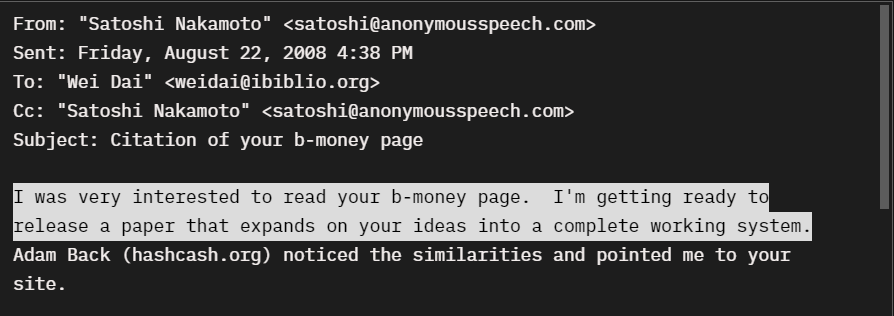
Then in the same year of 1998, a computer science graduate by the name of Wei Dai came along with a proposal for a solution to decentralised ledger coordination, which he called b-money.
His idea was simple: everyone can hash and guess with their computers, spending a little bit of computer time to figure out who is elected to update the ledger. That way, no one knows who gets to update the ledger, but everyone gets to try to be elected to update the ledger. And as a reward, they can win a digital unit that may someday have some value.
Although b-money was also never implemented in practice and left important details unsolved, Satoshi Nakamoto cited it in the Bitcoin whitepaper.
Peer-to-Peer (2001)
By the early 2000s, the missing brick was not cryptography or economics, but coordination at scale. How do you get thousands or millions of untrusted peers to cooperate on a single shared state without a central server?
In 2001, a man named Bram Cohen provided an answer to this question through his BitTorrent protocol, which demonstrated a practical way for peer-to-peer file sharing.
A mechanism that breaks a file into many small pieces that are shared across a network of users. Each user downloads pieces from others while at the same time uploading pieces they already have. This way, every user acts as both a consumer and a provider of data.
Although Bitcoin does not reuse BitTorrent's code, it follows a similar peer-to-peer logic. Nodes gossip blocks and transactions to each other, but no central server tells the network which history to adopt.
Reusable Proof of Work (2004)
To round off here, we need to remember proof of work and its lineage? Well, it did not stop at Nick Szabo. Before it reached Satoshi, it also had to go through another cryptographer known as Hal Finney.

It was in 2004, and Hal Finney proposed a new concept of proof of work he called Reusable Proofs of Work which took tokens generated via Hashcash-style proof of work and allowed them to be 'redeemed' for new tokens via a trusted server.
However, it was not fully decentralised because it relied on a central server, but still it succeeded in showing that proof of work could represent transferable digital value. It is no accident that when Satoshi released the first Bitcoin software in January 2009, Hal Finney was among the first to run it and received the first Bitcoin transaction shortly afterwards.
What Did Satoshi Actually Invent?
So what did Nakamoto actually invent? When you view the preceding decades as a series of bricks, Satoshi's true inventions come into focus.
The first one is the difficulty adjustment, which is the mechanism where the difficulty of creating new blocks (mining) adjusts. If miners are finding blocks too quickly, the difficulty increases, and if they are taking too long, it decreases.
The second Satoshi invention is the game-theoretic incentives, where under reasonable assumptions, the cheapest way to benefit from the network is to help secure it because trying to cheat becomes more expensive. And with those two inventions and the bricks laid down by others in the early days, Satoshi had the final decision to stand on the shoulders and give us the blockchain system we know today.
Connect with Bitfinity Network
Bitfinity Wallet | Bitfinity Network | Twitter | Telegram | Discord | Github
*Important Disclaimer: The information provided on this website is for general informational purposes only and should not be considered financial or investment advice. While we strive for accuracy, Bitfinity makes no representations or warranties regarding the completeness, accuracy, or reliability of the content and is not responsible for any errors or omissions, or for any outcomes resulting from the use of this information. The content may include opinions and forward-looking statements that involve risks and uncertainties, and any reliance on this information is at your own risk.
External links are provided for convenience, and we recommend verifying information before taking any action. Bitfinity is not liable for any direct or indirect losses or damages arising from the use of this information.

Comments ()